| |
|
|
 |
| |
|
 |
| |
| |
 |
|
Food processing industries are concerned with
hygiene management and desire to improve procedures.
The most popular sterilizer is hypo-sodium chlorate
because it provides excellent sterilization with
low cost and is easy to handle. Heat treatment is
also good, but there are occasional complaints from
customers because the odor of chlorine remains when
the package is opened.
Chlorine or HCIO etrium is in strong acidic water
and it can be used as sterilizer. Odor residue is
brief and thus is not a problem. |
|
| |
|
 |
| |
| |
 |
|
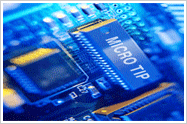
Semiconductor manufacturing creates pollution
and, thus, eliminating pollution is an important
task.
The objective of semiconductor cleaning is to remove
pollutants from semiconductor surfaces.
The size of particles to be eliminated is 1/2 ~
1/10th of the circuit design. As the detailing of
semiconductor progresses, surface pollutants affect
credibility or yield.
Individual cleaning is required to prevent this
pollution.
The sterilization effect of acidic water may be
used to clean
semiconductors. |
|
| |
|
 |
| |
| |
 |
|
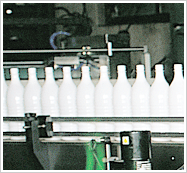
This procedure is used in factories that produce
medical or agricultural products as well as beverage
manufacturers (soft drinks or beer) and others.
Storage tanks become dirty with the accumulation
of protein and yeast fungus from soft drinks or
beer. Sodium hydroxide or hypo-sodium chlorate was
used for the cleaning in the past. Instead of using
chemicals, strong acidic water and alkaline water
are used.
The size of the tank can be up to 100 kiloliters,
equivalent to a size of a building.
Cleaning at room temperature is possible when an
electrolytic solution is used and, thus, additional
energy is not needed for heating cleaning water.
Moreover, recycling the used cleaning water is under
study for addition for energy savings. |
|
| |
|
| |
|
|
|